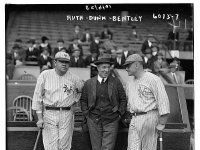
The year was 1925. If you were a sportswriter or just a casual fan listening to the chatter in any American bar, the consensus was grim. Babe Ruth was done.
He was thirty-one. In baseball’s harsh arithmetic, that was considered ancient. Fred Lieb, a respected columnist, had already declared him an “old 31.” The stats looked like a museum exhibit. Ruth had racked up 356 career home runs. He had surpassed the 1,000 RBI mark. His career batting average sat at a respectable .345.
Statistically, he was already immortal. If his career really had ended there, most historians would still put him on every all-time team imaginable. But the experts were wrong. Dead wrong.
They didn’t get him. They thought he had peaked too early. They failed to see that the man they thought was mature was actually just starting to grow into his power. The version of Ruth that Brother Matthias had seen in a Catholic orphanage twenty-five years prior was still evolving. The comeback wasn’t just coming. It was already in motion.
The Artie McGovern Detox
Ruth knew something was off. Or maybe he just knew he needed to prove the naysayers wrong. He decided to undergo a rigorous physical overhaul.
He handed his care to Artie McGovern, a gym owner in Manhattan with a reputation for being less of a trainer and more of a drill sergeant. When Ruth first stepped on the scale for the new regimen, he weighed 256 pounds. That wasn’t just heavy. That was heavy for a man whose primary sport involved hitting things as far as possible while standing still.
McGovern didn’t coddle. He didn’t negotiate. He put Ruth through four-hour daily workouts. He controlled the diet with military precision.
By the time the team headed to spring training in 1926, the transformation was visible. Ruth wasn’t just lighter. He was 212 pounds of lean, coiled muscle. The blood pressure issues that had plagued him? Gone. The waistline? Shaved by nine inches. The hips? Six inches tighter.
He had to buy new shirts. His old collars hung loose. He looked like the “keed” who had terrorized the league in 1920 and 1921, but this time, he felt it.
The Questionable Yankees
The 1926 New York Yankees were a walking contradiction. They had potential written all over them. They also had more question marks than a mystery novel.
The infield was young. Rookie Mark Koenig and rookie Tony Lazzeri held down the keystone positions. Lazzeri was already a legend in the making. He was the only player in pro baseball history to hit more home runs in a single season than Babe Ruth. In 1925, playing for the Pacific Coast League, Lazzeri had blasted 60 homers across 197 games.
At first base, Lou Gehrig was establishing his name. But don’t look at the legacy and assume he was a god yet. In 1925, Gehrig hit .295 with 20 home runs. Solid. Not legendary. Not yet.
The pitching staff was ancient. Waite Hoyt was 26. He was the youngest starter. The next man up was six years older. That’s old for a starter in any era.
Spring training didn’t help the narrative. The Yankees lost their first two games to the Boston Braves. The final score combined for a humiliating 28 runs.
The experts pounced. They were still smarting from predicting the 1925 team would win the pennant only to finish seventh. Westbrook Pegler, a writer with a pen sharp enough to cut glass, called the 1926 Yankees “the worst team he ever saw.” He predicted last place. He was sure of it.
But the team was jelling.
The pitching was better than advertised. The offense was waking up. The Yankees went on an 18-game winning streak to close out spring training. The last dozen games were against the Dodgers, who traveled north with them. It wasn’t just practice anymore. It was a statement.
The Regular Season Surge
The Yankees didn’t just avoid last place. They didn’t even hover in second.
A 16-game winning streak in June stretched their lead to six games. By June 1, they were running away with it.
On September 25, something historic happened. Ruth, Gehrig, and Bob Meusel hit home runs in succession. It was the first time that trio had done it in the majors in 23 years.
The Cleveland Indians, led by ace pitcher George Uhle, made a late charge. Ruth and his nemesis Uhle had history. Cleveland finished only three games back. The Yankees cooled off slightly, but the lead was too big.
Statistically, the team was a monster. Their team ERA was only fourth in the league. But they outscored every other team by at least 45 runs. Offense was the name of the game.
Gehrig led the league with 20 triples. He added 16 home runs and hit .313. Lazzeri contributed 14 triples and 18 home runs. Bob Meusel played only 108 games after breaking a bone in his foot, but still swatted 12 homers and drove in 81 runs.
The Yankees were second in batting average. They led the American League in on-base percentage. They led the league in slugging average. It wasn’t close.
The Father Figure
Ruth’s individual stats were absurd. He led the league in home runs with 47. He led in runs scored. He led in RBI. He led in walks. He finished second in batting average.
To show he wasn’t just a lone wolf, he laid down 10 sacrifice bunts. A baseball player who sacrifices himself for the team? Unheard of for the Sultan of Swat. But the sweat in McGovern’s gym had paid off. He was disciplined.
A figure from his past intervened in June. Chicago was hosting the International Eucharistic Congress. It was a massive gathering of devout Catholics. The Yankees were in town. They invited Brother Matthias to join them from Baltimore.
Ruth had dinner with him. Matthias was the surrogate father who had seen the boy in the orphanage. He delivered a personal sermon. He told Ruth about the evil of his ways.
Ruth listened. He took it to heart. At least for a little while.
His marriage to Helen was effectively over. The farm in Sudbury was sold. Helen and their daughter Dorothy had moved to Boston. The last time the three of them appeared together publicly was that year’s World Series.
The Fall Classic
The Yankees faced the St. Louis Cardinals. This wasn’t a mismatch. The Cardinals were an offensive powerhouse led by player-manager Rogers Hornsby. Hornsby was arguably the greatest right-handed hitter of all time.
Game 1 was a pitcher’s duel. Billy Sherdel for the Redbirds, Herb Pennock for the Yankees. The score was tied 1-1 in the bottom of the sixth.
Ruth led off with a single. Bob Meusel bunted him to second. Gehrig singled, scoring Ruth. The Yankees took the lead.
Game 2 was a different story. The Cardinals sent out Grover Cleveland “Pete” Alexander. He was 39 years old. He was an alcoholic. He was an epileptic. He was a legend.
Alexander held the Yankees to four hits. He won 6-2.
The series moved to St. Louis. Jesse Haines shut out the Yankees in Game 3. Five hits. A loss.
Game 4 became legend.
The first two Yankees batters struck out. Pressure mounted. Then Babe Ruth stepped into the box.
He faced Flint Rhem. On the very first pitch, Ruth slugged a home run. He did it again in the third inning. Two more home runs in one game. The series was tied, but the message was clear.
The experts said he was done. The gym said otherwise. The season proved that Ruth wasn’t just a player. He was a force of nature that refused to be contained.
The First National Broadcast and Ruth’s Historic Power
This wasn’t just a game. It was the first World Series game ever broadcast nationally. Thirty-three radio stations carried Graham MacNamee’s booming voice into homes across the country. When Babe Ruth stepped up to the plate in the sixth inning against Hi Bell, the call went down in history.
MacNamee didn’t just describe the at-bat. He channeled pure electricity. He noted Ruth’s shoulders looked like there was “murder in them.” He said that great big bat of Ruth’s looked like a toothpick next to his massive frame. Three and two count. The Babe waved that bat over the plate. Bell threw it. Ruth launched it clear into the centerfield bleachers.
“Did you hear what I said?” MacNamee yelled. “Where is that fellow who told me not to talk about Ruth anymore? Send him up here.”
It was a World Series record. Three home runs in one game. MacNamee claimed it was the longest hit ever made at Sportsman’s Park. A mile and a half away. Ruth scored four runs. Drove in four. The Yankees romped to a 10-5 win.
The Turning Point: Game 6 and the Cost of Victory
The momentum shifted quickly. The next day, another pitchers’ duel dragged to ten innings. The Yankees won 2-1. But then came Game 6.
Grover Cleveland Alexander, the Cardinals’ ace, spun his magic again. He held Ruth hitless. Alexander won 10-2. The Cards were alive.
Game 7 was a grind. Ruth’s third-inning homer gave New York a one-run lead. Then the Cards pushed three runs across in the fourth. Ruth walked again in the fifth. It was his ninth walk of the Series. He broke an old record. He would walk two more times. A run in the sixth cut the deficit to one.
The Final Out: A Strategic Gamble or a Fatal Error?
In the bottom of the seventh, the Yankees loaded the bases. Combs singled. Bunted to second. Ruth walked intentionally. Gehrig walked. Two down. Bases loaded.
Cardinal manager Rogers Hornsby sent in the rocky veteran Alexander. He was aging. Some said he was hungover from the day before. Hornsby stared into Alexander’s eyes. Satisfied.
Without warming up in the bullpen, Alexander struck out Lazzeri. The rookie had epilepsy too. A coincidence that didn’t matter in the heat of the moment.
Alexander retired the next three quickly. In the ninth, he walked Ruth on a 3-2 count. Alexander later insisted ball three was strike three. Ball four was a strike too. One strike to Bob Meusel.
Then, Ruth did it.
He took off for second base. Bob O’Farrell threw him out easily. The game ended. The Series ended. The Yankees lost.
The Logic Behind the Steal Attempt
Ed Barrow and others called the steal attempt stupid. Ruth didn’t care. His logic was sound. Getting into scoring position with two outs increased the chances of tying the game.
Ruth wasn’t slow. He had stolen eleven bases during the season. He had already stolen one base against O’Farrell the day before. The Cardinals won their third Series in four appearances. The Yankees would go on to win eight more before losing again. But that moment in the ninth inning of Game 7 defined the era.
The Johnny Sylvester Myth vs. Reality
One of the most enduring stories in baseball history has its roots in this Series. The legend says a sick boy named Johnny Sylvester lay on his deathbed after a horse-riding accident. Ruth visited him. Promised a home run.
That afternoon, Ruth hit three home runs. The boy recovered. Sportswriters claimed Ruth’s power saved his life. Years later, the grown boy thanked the Babe. They wept.
The facts are different.
Johnny’s dad wired Ruth from New Jersey. Asked for an autographed ball. The Yankees and Cardinals each sent one. The kid was grateful. No promise was made.
After the Series, Ruth barnstormed. He showed up at the Sylvester home one day on an impulse. Chatted with Johnny. A year later, Johnny’s uncle met Ruth and thanked him for saving the lad. Ruth smiled. Asked how Johnny was. Then turned to a friend and said, “Now who… [is] Johnny Sylvester?”
The story stuck anyway. It was better than the truth.
Ruth made money from this era too. The barnstorming routine was a hit. He performed as a solo act in vaudeville. A 12-week tour. Earned him $65,000.
The 1927 season began soon. The legend had taken root.