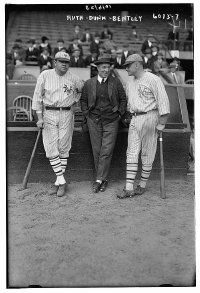
Babe Ruth didn’t just train for the 1928 baseball season. He tormented himself for it. Under the brutal watch of trainer Artie McGovern, Ruth endured daily grueling workouts that left him physically five to ten years younger than his previous self. McGovern claimed the regimen worked. Ruth looked better. Moved faster. Hit harder.
But you know Babe. He still indulged. Just in new ways. Bridge. Fox hunting—he could sweat off five pounds on a horse in a single day. The saxophone. He mastered one song. Maybe two. We don’t know. The only vice he couldn’t drop was his heavy foot on the gas pedal. He got arrested for speeding again in May 1928. Some habits die hard.
The 1928 Yanks Lineup and Early Dominance
The Yankees’ core stayed mostly the same for 1928, save for two moves. They signed young catcher Bill Dickey. They grabbed Leo Durocher as an infield fill-in. The pitching staff? That was a mess.
Urban Shocker, the 37-year-old who won 18 games in 1927, left during spring training. His heart condition was too debilitating. He died that September. Herb Pennock battled illness too, losing his edge. George Pipgras stepped up. Waite Hoyt remained consistent.
The Yanks opened by trouncing the Philadelphia A’s. They never looked back. By Independence Day, they held a 13.5 game lead over Philadelphia. By early August, Ruth had 42 homers. He was 26 games ahead of his 60-homer pace from 1927. Spoiler alert: he would only hit a dozen more all season.
Then the injuries hit. Tony Lazzeri went down with a shoulder problem. This made Durocher’s arrival crucial, even though Ruth hated him, calling the infielder a dandy.
The unstoppable scoring machine started getting stopped. The Athletics, meanwhile, were evolving into one of the greatest teams of the century. The energetic young A’s drove forward. The vaunted Yanks stumbled.
The Yankees Catch Fire in September
Drama. That was this team’s flavor. By September 9, the A’s had moved into first place by half a game. The setting: a New York doubleheader.
8,000 standing room tickets went on sale. 25,000 people tried to buy them. Police had to quell the bedlam. Attendance hit 85,265. Yankee Stadium had been enlarged over the offseason to handle the crush.
The Yanks swept Philadelphia that day. After a day off, Ruth untied the next game in the eighth inning with a two-run homer off Lefty Grove. The New York Times called it “the Ruth, the whole Ruth, and nothing but the Ruth.” The Philadelphia spirit broke. The Yanks finished 2.5 games ahead.
But once the regular season ended, Ruth stopped hitting entirely. Historian Lee Allen captured the mood perfectly: “A large man in a camel’s-hair coat and camel’s-hair cap, standing in front of a hotel, his broad nostrils sniffing at the promise of the night.”
Manager Miller Huggins considered suspending Ruth for his post-season antics. He thought better of it. Who would laugh? The team was in first place.
The pennant-clinching celebration in Detroit was riotous. Ruth wanted a piano. The hotel had none. So the Babe bought one and had it delivered.
Physically, the Yankees were wrecked. Mark Koenig, Ruth, Lou Gehrig, Joe Dugan, and Lazzeri all carried injuries. Pennock didn’t pitch after August due to a sore arm. Earle Combs tweaked his wrist two days before the season ended. They were beat up. They were ready.
The 1928 World Series: Ruth vs. The Cardinals
Predictions favored the St. Louis Cardinals. Bill McKechnie managed them now. The odds were 6-5 on the Cards. Why? Because the 1926 Cardinals had figured out how to avoid Babe Ruth. They walked him 11 times.
McKechnie made a tactical error. He decided to pitch to the big guy.
The Yankees outscored the Cardinals 20-7 in the first three games. Ruth had seven hits and scored six runs. In Game 4, the Yanks trailed 2-1. Then, “five o’clock lightning” struck in the seventh inning.
Cardinals pitcher Billy Sherdel tried a “quick pitch” on Ruth. Legal in the National League. Illegal in the American League. Commissioner Landis had banned it for the Series. The umpire ruled no pitch. St. Louis fans and players erupted.
Ruth walked around the arguing clusters with a broad grin. Then he did something iconic. He barked at Sherdel: “Put one right here and I’ll knock it out of the park.”
Sherdel took the bait. Ruth hit the ball over the rightfield pavilion. Gehrig followed with a homer. The Yanks added two more runs before the inning ended. Then another deuce in the eighth off Pete Alexander, fueled by Ruth’s third homer of the game.
The game belonged to the Babe. So he ended it with a flourish. In the bottom of the ninth, the Cards scored once and put two men on. Frank Frisch lofted a foul fly down the leftfield line. Ruth charged over and snagged it on a dead run before it hit the temporary seats. He held it aloft for all to see as he hustled into the dugout.
The series was all but over. The dynasty continued. But the body was breaking down. How long could this last?
Why the 1928 World Series Actually Belonged to the Yankees
Let’s clear up a common misconception right away. The 1927 World Series? Not the blowout people claim. The 1928 Series, however? That was a total domination. The Yankees didn’t just win; they celebrated with the kind of excess that defined the franchise. Babe Ruth famously held the return train hostage until the crew loaded enough food for the ride home. We’re talking four bushels of spare ribs.
The journey from St. Louis to New York turned into a rolling parade. Every time the train slowed through a small town, crowds gathered. Ruth appeared on the platform dozens of times. His politeness varied, but the fans didn’t care. They just wanted to see him.
Ruth capped off 1928 strong. But 1929 was coming, and things were about to shift.
The 1928 Series was a Yankee blowout.
If you want to dig deeper into baseball history, check out these resources:
- Baseball history archives
- Minor League Baseball records
- Baseball Hall of Fame profiles