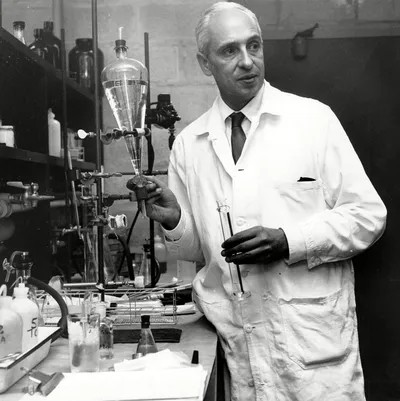
Severo Ochoa did not just discover an enzyme. He unlocked a door to understanding how cells build proteins, a feat that earned him the 1959 Nobel Prize in Physiology or Medicine. He shared that honor with Arthur Kornberg, but Ochoa’s work specifically targeted ribonucleic acid (RNA). This substance is the critical middleman between DNA’s genetic code and the proteins that actually run a cell.
Born in Luarca, Spain, on September 24, 1905, Ochoa was a man of many borders. He eventually became a U.S. citizen in 1956. He died in Madrid on November 1, 1993. His career was a map of scientific migration, moving from Spain to Germany, back to Spain, and then across the Atlantic to the United States.
A Global Education in Biochemistry
Ochoa’s path started at the University of Madrid. He earned his M.D. in 1929. That was just the beginning. He spent two years in Heidelberg, Germany, studying muscle biochemistry and physiology under Otto Meyerhof. Meyerhof was a giant in the field. This training gave Ochoa a deep appreciation for the energy dynamics of living tissue.
He returned to Spain to head the physiology division at the Institute for Medical Research at the University of Madrid in 1935. The late 1930s took him to Oxford, where he investigated thiamine (vitamin B1). He spent four years there, from 1938 to 1941.
By 1942, Ochoa had crossed the ocean. He joined New York University as a research associate in medicine. By 1946, he was a professor of pharmacology. The trajectory was clear. He rose quickly. By 1954, he was the chairman of the biochemistry department at NYU.
The Enzyme That Wasn’t What It Seemed
The discovery that would define his legacy happened in 1955. Ochoa was researching high-energy phosphates. He isolated an enzyme from bacteria. He named it polynucleotide phosphorylase.
At the time, he believed this enzyme synthesized RNA. That belief was wrong.
Later research showed that the enzyme’s natural job in bacteria is to degrade RNA. It breaks it down. However, in a test tube, chemical conditions can force the reaction to run in reverse. Under those specific artificial conditions, the enzyme can build RNA strands.
The enzyme has been singularly valuable in enabling scientists to understand and re-create the process whereby the hereditary information contained in genes is translated, through RNA intermediaries, into enzymes that determine the functions and character of each cell.
This distinction mattered less than the utility of the tool. Scientists needed a way to create RNA chains in the lab. They didn’t have many. Polynucleotide phosphorylase provided that capability.
Why This Matters for RNA Research
Before this discovery, the mechanism of genetic translation was largely theoretical. Genes held information. Proteins did the work. But the bridge between them was obscure.
Ochoa’s enzyme allowed researchers to synthesize RNA chains with specific sequences. They could then study how these