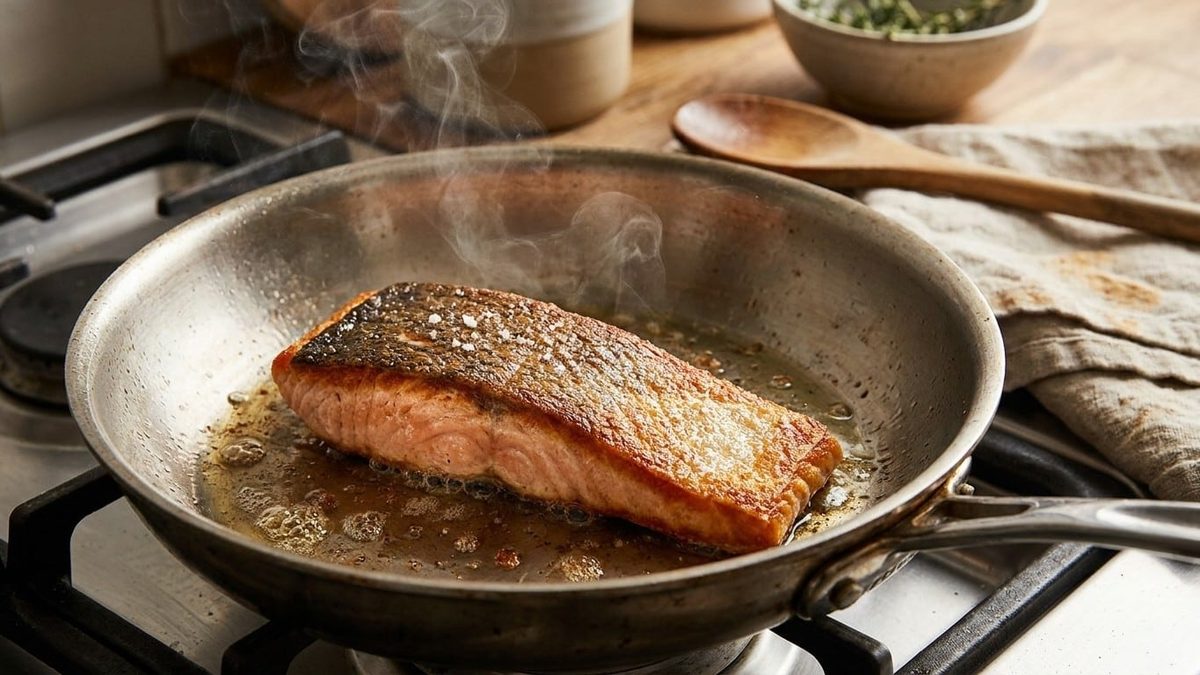
Most people put oil in a hot pan. Then they drop the fish in. It sticks. It steams. The skin gets rubbery instead of crunchy.
Stop doing that.
The best way to cook salmon skin-side down in a cold pan isn’t just a tip. It is the only way to guarantee a crackling skin and moist, nacreous flesh without guessing. A comparison by Food & Wine tested six methods. Grilling. Oven. Steam. Classic sauté. Air fryer. And the cold-start method.
The cold-start won. Hands down.
It produces skin that shatters when you press it. And meat that stays tender. Here is how to actually do it.
Why Starting Cold Beats Thermal Shock
A freezing fillet hitting a screaming hot pan is a disaster. You are talking about a 4°C piece of fish hitting a 200°C surface. That is thermal shock. The proteins seize. The skin bonds to the metal instantly. You peel it off later, and you rip the flesh apart.
Starting cold avoids this trap.
You place the pavé skin-side down on the cold metal. No fat. No sizzle yet. Then you turn on the heat.
The fat under the skin begins to melt slowly. It renders out gently. It does not burn. The heat penetrates the meat gradually.
This is the same logic chefs use for duck breast. Skin down. Low to medium heat. Render the fat out. Flip at the very end.
Professional forums agree. The goal is to let the skin protect the delicate flesh while it cooks. The skin becomes a shield. Once it is golden and crisp, the fillet releases itself. No forcing. No scraping.
The Invisible Step: Drying the Skin
You cannot get crispy skin with wet fish. It is physics.
Water creates steam. Steam prevents browning. If your salmon is damp from the fridge, that moisture turns to vapor on contact with heat. You are not frying. You are boiling your fish from the skin side.
The skin stays soggy. The texture fails.
Before the pan even touches the stove, you must dry the fillet. Vigorously. Use paper towels. Press hard on every side. Especially the skin. It must be bone dry to the touch.
Also, let the fish come to room temperature. Pull it out 10 to 15 minutes before cooking. A rock-cold fillet cooks unevenly. The outside burns before the inside thaws.
The 80/20 Rule for Perfect Timing
Once the fire is lit, patience is the main ingredient. How long does the skin stay down?
There is a simple rule. The 80/20 split.
For a standard 3 to 4 cm thick pavé, spend 80% of the total cooking time skin-side down. 20% on the flesh side.
Why? The skin acts as an insulator. It protects the tender meat from direct, aggressive heat. The flesh needs less time. The skin needs the long, slow render to become crisp.
For thinner fillets (2 to 2.5 cm), this usually means 3 to 4 minutes skin-side down. Then flip. Just once. Cook the flesh for the remaining minute or so.
Some chefs go further. They cook until the sides turn mostly opaque. About 5 minutes. They press gently with a spatula during the first 30 seconds. This keeps the skin flat against the pan. It stops the skin from curling up and retracting.
Visual Cues Over Timers
Forget the thermometer. It is overkill for salmon.
Watch the side of the fillet. You will see a line of opaque, white flesh rising from the skin side upward.
When that opaque line reaches about two-thirds of the fillet’s thickness, it is time to flip.
The center will remain rare and nacreous. That is the target. Moist. Flaky. Not dry.
Common Mistakes That Ruin the Dish
Even with the cold-start method, you can still mess up.
Saliing too early is a classic error. Salt draws out moisture. If you salt the skin 20 minutes before cooking, it will sweat. It will not crisp. Salt only at the end. Or season the flesh side lightly before cooking, but leave the skin dry.
Flipping too often is another trap. Impatience kills crispness. The skin needs uninterrupted contact with the pan. Flip once. Only once.
Bumping the fillet. The skin shrinks when heated. If you leave it alone for the first few seconds, it curls. Press it lightly with a flat spatula for the first 30 seconds. Keep it flat.
And stop fearing stainless steel. The myth is that skin sticks to stainless. It doesn’t. If the technique is right, the skin releases cleanly. It is the naked flesh that sticks. The skin is the hero here.
It is counter-intuitive. Cold pan. Raw fish. No oil splattering immediately. But it works. Because it respects the physics of fat and heat. Try it once. The texture difference will be loud.