


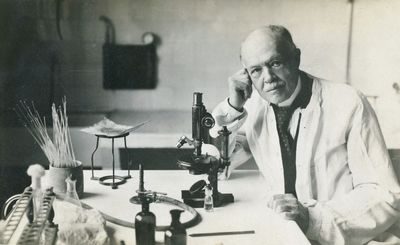
Charles Jules Henri Nicolle didn’t just study bacteria. He observed how they passed from person to person.
Born in Rouen, France in 1866, Nicollee became one of the most important figures in medicine in the early 20th century. He died in Tunis in 1936. But his legacy rests on an important discovery made in 1909. He showed that lice could spread typhus.
This discovery earned him the Nobel Prize in Physiology or Medicine in 1928. The way infectious diseases are treated in hospitals has also changed.
Tunisn contact information
Nicollee got his medical degree in Paris in 1893 and returned to Rouen to teach and research. In 1902, he took a job at the Pasteur Institute in Tunis.
He stayed there for 31 years.
Under his leadership, the institute became a world-class center. They produce serums and vaccines to fight infectious diseases. But Nicollee was focused on one particular thing. Typhus quickly spread outside the walls of the hospital. Sick people entering the building are highly contagious. Once admitted, they stopped being so.
Why the change?
Nicollee doubted the admission process itself. Bathing a new patient. Their old clothes were taken away. When these clothes were removed, the spread of the disease stopped.
The culprit must be in the clothes or the skin.
Lying in Wait
What lives in your clothes? Nicollee observed body lice (Pediculus humanus humanus ).
He tested this hypothesis with monkeys. The results are clear. Lice spread the typhus bacteria. Wash the patient. Change your clothes. Stop spreading it.
This is not just a theory. This is practical, life-saving evidence.
Beyond Typhus
Nicollee didn’t stop at one disease. He distinguished two types of typhus.
One form is louse-borne. It is transmitted through body lice. Another is murine typhus. Rat fleas spread. Understanding the differences is important for treatment and prevention.
His work expanded even further. He made a significant contribution to the understanding of rinderpest. Brucellosis. measles. diphtheria. tuberculosis.
Nicolle shows that observation is just as effective as laboratory research. He saw a pattern. he tested it. he proved it.
Lice are often considered a nuisance. Nicollee points out that it is the vector of death. He also showed how easy it is to stop it.


