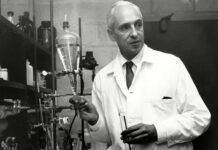
The human body is a fortress. You know this instinctively. But for most of the 20th century, biologists were trying to understand the architecture without seeing the blueprint. Enter George E. Palade.
He didn’t just look at cells. He learned how to freeze them in time, slice them thinner than a thought, and stare into their deepest recesses using electron microscopy. His work didn’t just add to the textbook. It rewrote the manual on how life functions at the microscopic level.
Born in Iași, Romania, in 1912, Palade was a man of two worlds. He earned his medical degree from the University of Bucharest in 1940. He stayed, teaching until the ashes of World War II cooled. Then, in 1946, he crossed the Atlantic. He landed at the Rockefeller Institute in New York, carrying with him a toolkit of techniques that would change science forever.
The Mystery of the Microsomes
Before Palade’s work, the cell interior was a blur. Scientists knew about mitochondria (the power plants). They knew about the Golgi apparatus (the post office). But there was a mystery substance called “microsomes.”
What were they? Everyone assumed they were just broken bits of mitochondria. Fragments. Debris.
Palade proved them wrong.
Using advanced centrifuging techniques and tissue-preparation methods he helped develop, he showed that microsomes weren’t garbage. They were functional, vital parts of the endoplasmic reticulum—the internal highway system of the cell. They were packed with ribonucleic acid (RNA).
We call them ribosomes today. That is one of the most critical terms in biology. Without ribosomes, the cell cannot build proteins. Without proteins, you do not exist. Palade identified them. He gave them a name. He explained their function.
A Shared Legacy
He wasn’t working in a vacuum. He shared the 1974 Nobel Prize in Physiology or Medicine with Albert Claude and Christian de Duve. The prize recognized their discovery that “cells are organized units.” Palade’s specific contribution? He provided the visual proof and the structural clarity.
He became a naturalized U.S. citizen in 1952. By 1958, he was a professor of cytology at Rockefeller. But he kept pushing. He moved to Yale in 1972. Then, in 1990, he settled at the University of California, San Diego (UCSD). There, he served as dean for scientific affairs. He built an exceptional cell biology program. He retired in 2001 as professor emeritus.
He died in Del Mar, California, on October 7, 2008, aged 95.
Why It Matters Now
You might wonder why a man who died over a decade ago still matters. It’s simple. Every time a doctor prescribes a drug that targets a specific cellular pathway, or when a researcher studies how a virus hijacks ribosomes to replicate, they are walking in the space Palade mapped out.
His work answered the “how” of cellular organization. How do nutrients get processed? How are proteins synthesized? Where do they go next?