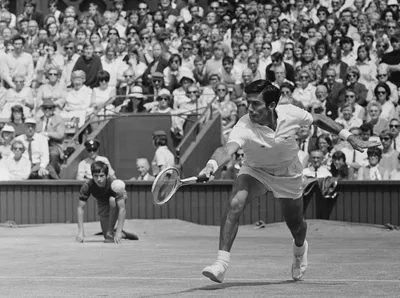
Ken Rosewall didn’t look like a tennis god. Born in Sydney in 1934, he was slight. Short. You could probably bench press him. Yet he dominated the sport for a quarter-century, accumulating 18 Grand Slam titles while never suffering a career-ending injury. He wasn’t built for power. He was built for precision. And that precision broke the game.
The Hoad Partnership and Early Dominance
Rosewall arrived on the scene in 1953. He swept the Australian and French Open singles titles. That same year, he teamed up with fellow Australian Lew Hoad. They cleaned up the doubles draws. They won in Australia, France, and at Wimbledon. By 1955, Rosewall had taken another Australian Open singles crown.
Then came 1956. The big one. Rosewall and Hoad marched the Davis Cup from the United States, securing international doubles glory along the way. It was the peak of the amateur era, and Rosewall was already a legend.
Turning Pro and Waiting for Open Tennis
He flipped the switch in 1956. Rosewall turned professional. He immediately claimed the U.S. Open men’s singles championship. He wasn’t done there. He picked up pro singles titles in 1963, 1965, and 1971. But those wins were in a shadow league, separate from the amateur majors.
The real magic happened when Open Tennis arrived in 1968. Suddenly, pros could play the Grand Slams. Rosewall was 33. Most players retire by then. He won his second French Open that year. He didn’t stop.
In 1970, he faced Tony Roche. Roche was the favorite. Rosewall didn’t care. He won the U.S. Open. Fourteen years had passed since he beat Hoad at the same event. The gap between his first and second U.S. Open title was longer than the careers of most modern players.
The Final Act and Legacy
The 1970s were a blur of wins. He took the Australian singles title in 1971 and 1972. He helped Australia secure the 1973 Davis Cup. Then came the grueling final stretch.
- Rosewall was 39. He made the finals at Wimbledon. He made the finals at the U.S. Open. Jimmy Connors beat him in both. But the score didn’t matter as much as the fact that he was there. Many observers were stunned that a man approaching 40 could compete with the younger, harder-hitting generation.
His last tour victory came in 1977. A career spanning from 1953 to 1977. He ended with nine doubles championships and one mixed doubles title. Eight singles majors. Eighteen Grand Slams total.
He entered the International Tennis Hall of Fame in 1980. Not because he was the strongest. Not because he was the biggest. But because he figured out how to outlast everyone else.
You watch the modern game now. You see the power. The serves that hit 130 miles per hour. The baseline