


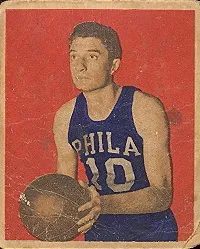

Joe Fulks didn’t invent the jump shot, but he made it the standard. In the 1940s, professional basketball relied on one-handed and two-handed set shots, rigid and predictable. Fulks shattered that norm by using the jump shot extensively, fundamentally altering how the game was played. He was the first forward to treat airball attempts as a strategic weapon rather than a last resort.
The Warrior Who Redefined Scoring
Standing 6’5″ and described as a whippet, Fulks shot with reckless abandon. He would cast turnaround jumpers from 20 feet if the mood struck him. During his first three professional seasons, before the 24-second shot clock forced faster pace, he led the Basketball Association of America (BAA) in shooting attempts, averaging nearly 30 per game.
His volume was staggering for the era. In the 1946-47 season, Fulks averaged 23.2 points per game. That total was eye-popping at the time. It was 6.4 points higher than his nearest competitor in the scoring race. He led the BAA in scoring twice, establishing himself as the league’s primary offensive threat.
From Kentucky to Philadelphia Championship
Born on October 26, 1921, in Birmingham, Kentucky, Fulks played college basketball at Murray State in relative obscurity. He then served a three-year tour in the military. While he was away, Eddie Gottlieb formed the Philadelphia Warriors and needed talent. Gottlieb was advised that Fulks could help, and he signed the forward to a contract in 1946.
Fulks became the engine of the Warriors’ offense. In the spring of 1947, the team beat the Chicago Stags 4-1 to claim the BAA championship. Fulks delivered in the big moments. He scored 37 points in the first game of the series and 34 in the final game. The Warriors’ title run cemented his status as a franchise cornerstone.
Breaking the One-Game Scoring Record
On February 10, 1949, Fulks obliterated the one-game scoring record. He dropped 63 points against the Indianapolis Jets. That record stood for a full decade. It finally fell in 1959 when Elgin Baylor scored 64. Fulks’s performance that night was so dominant that he earned a spot on the 1948-49 all-league team. That squad also featured George Mikan, Jim Pollard, Max Zaslofsky, and Bobby Davies.
Why the Jump Shot Changed Everything
Before Fulks, shooters stood at the rim or close by. They set their feet and fired. Fulks introduced movement. The jump shot allowed players to generate their own shot rhythm, bypassing defenders who relied on positioning. His willingness to shoot from mid-range and the perimeter opened up the floor. Coaches and players began to see that scoring could come from anywhere, not just the paint.
The End of an Era
Fulks’s scoring average dropped steadily after he turned 30. By 1954, he retired from the Warriors with a career average of 16.4 points per game. He stepped away from basketball after five years in the pros. His legacy was recognized later. In 1970, he was named to the NBA’s Silver Anniversary Team. A year after his death, in 1977, he was elected into the Basketball Hall of Fame.
Fulks died before seeing the game evolve into the three-point-heavy spectacle it is today. But without his willingness