


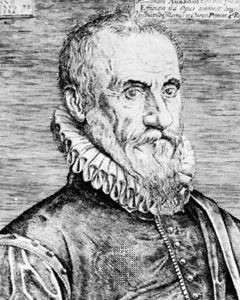
How #AmbroiseParé revolutionized modern surgery
Ambroise Paré didn’t just change the way wounds were treated. He redefined the role of the Renaissance surgeon. Paré was born in Bourg-Hersent, France, in 1510, died in Paris on December 20, 1590, and is now widely regarded as the father of modern surgery. Although his career spanned a brutal era of war and primitive medicine, he managed to bring compassion to an area that had nothing but everyday cruelty.
In 1533, Paré moved to Paris. He began his apprenticeship as a barber surgeon at Hôtel-Dieu. The training was hard, but the content was also rich. He studied anatomy. He studied surgery. In 1537 he was drafted into the army. He served as physician to four French kings: Henry II, Francis II, Charles IX and Henry III. His reputation grew rapidly and by 1552 he was the ruler’s chief surgeon.
Battlefield medical care was a nightmare at the time. Gunshot wounds are considered poisonous. The standard treatment is to pour boiling oil to “clean” the large holes. It’s painful. It often kills the patient.
Paré’s supply of boiling oil ran out during the battle. He has no choice. He mixed egg yolks, rose oil and turpentine. He applied this gentle salve to the vulnerable. The next day, the results were undeniable. Soldiers treated with oil slept soundly and recovered well. Those treated with boiling oil experienced extreme pain and fever.
In 1545, he published these discoveries in “La Méthod de traicter les playes faites par les arquebuses et aultres bastons à feu”. Critics mocked him. He wrote in French, not Latin. They call it amateur. They ignored the evidence.
Paré also tried the cruel practice of burning an amputated limb with a hot iron to stop the bleeding. He reintroduced tying the great arteries with thread. The speed is relatively slow. This takes skill. But it saves lives. It reduced shock. It didn’t get instant approval from the old guard, but it worked.
Unlike many of his contemporaries, Paré practiced self-control. Surgery is only performed when absolutely necessary. He was one of the first to end the castration of hernia repair patients. He displayed artificial teeth, limbs and eyes made of gold and silver. He invented scientific instruments. He recommended trusses for the treatment of hernia. He even suggested that syphilis was the cause of the aneurysms, although this relationship was not fully understood until centuries later.
Paré’s legacy extends beyond the tools he invented. This is the mentality he created. He looked at the traditions and asked if it was really useful. He chose proof over dogma.
In medicine, change happens slowly. Many surgeons insist on using a hot iron. They laughed at his French writings. However, the patient survived. That’s the most important thing.
History remembers him as a pioneer. But back then he was just a man trying to keep the soldiers alive with the contents of his bag. In some cases, the simplest concoctions are more effective than the most “scientific” tortures.
Today we continue to discuss the ethics of medical procedures.


